


From Web3 Marketplace to Stablecoin Wallet: What Building Kaza Taught Me About Users in Africa
- Ibukunoluwa Agboola

- 6 days ago
- 3 min read
Before June 2022, I was freelancing and exploring what the future of work could look like for African freelancers. Like many builders at the time, I was drawn to Web3—not just as a trend, but as a potential unlock for global access to income, ownership, and financial tools.
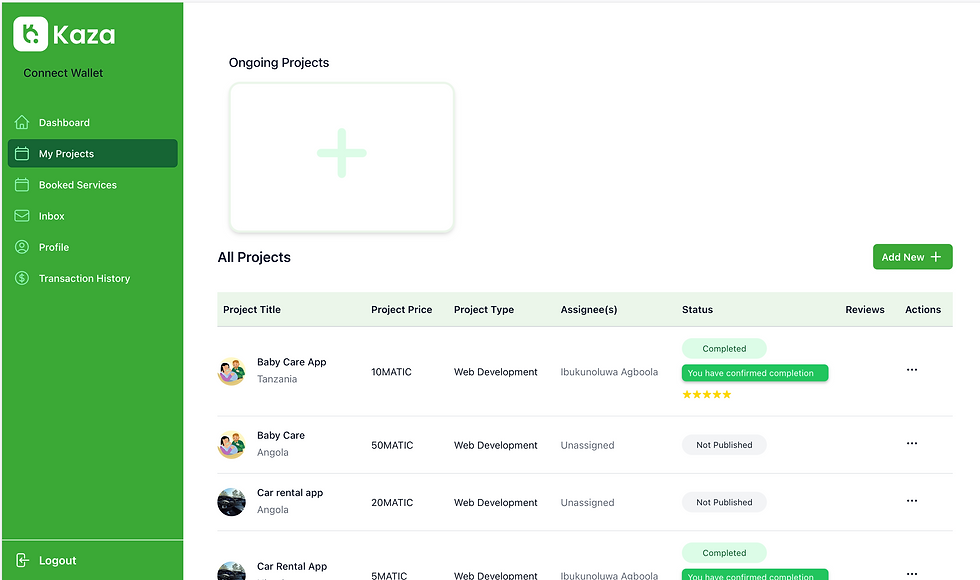
That curiosity led to the first version of Kaza: a Web3-powered freelance marketplace designed to connect freelancers with project owners.
On paper, it made sense.
We built a platform where users could connect their wallets, interact with escrow smart contracts, and collaborate without traditional intermediaries. The onboarding flow replaced the typical “Sign Up” button with a “Connect Wallet” option—allowing users to authenticate instantly using tools like MetaMask or Trust Wallet.

It was aligned with where the ecosystem was heading.
But when we launched, something didn’t quite click.
The Gap Between Possibility and Usability
Adoption was slower than expected. Most of our early users came through word of mouth, and while feedback was positive, engagement was limited.
The issue wasn’t the idea—it was the experience.
For many users, especially those new to Web3, the “Connect Wallet” flow introduced more friction than it removed. It assumed a level of familiarity with wallets, private keys, and blockchain interactions that simply didn’t exist for the average user we were trying to serve.
What we thought was simplifying onboarding was, in reality, shifting complexity onto the user.
That insight changed everything.
Rethinking the Role of Wallets
Instead of forcing users to adapt to Web3 tools, we began asking a different question:
What would this experience look like if the user didn’t need to know anything about Web3 at all?
This led to a pivot.
We started building a stablecoin wallet that abstracts away the complexity of blockchain interactions while still delivering the core benefits—global access, stability, and programmability.
The approach was hybrid:
Web2 for usability and familiar user flows
Web3 for settlement, custody models, and financial flexibility
We integrated infrastructure from providers like Circle and Bridge, alongside blockchain tooling such as Solana, to create a developer-controlled wallet experience.
The goal was simple:Make it possible for users to send, receive, and store value globally—without needing to manage external wallets or understand how blockchain works under the hood.
Building for the User, Not the Technology
This shift forced us to rethink not just our product, but our philosophy.
Early on, we were building with the assumption that users would adapt to new paradigms. In reality, most users just want something that works—reliably, intuitively, and without unnecessary cognitive load.
The lesson was clear:
The success of emerging technologies in Africa will depend less on their novelty and more on how seamlessly they integrate into everyday user experiences.
Where Kaza Is Today
Today, Kaza has evolved beyond its original marketplace concept.
Our wallet product (wallet.mykaza.co) focuses on simplifying access to digital finance, particularly for freelancers and creators who operate across borders.

We’ve also introduced Krowd Fund, a feature that allows users to support campaigns from creators—an extension of our broader goal to improve access to capital and financial tools.
These are still early steps, but they are grounded in a clearer understanding of the problem.

The Broader Opportunity
Across Africa, there is no shortage of innovation in fintech and Web3. But there is still a significant gap between what technology enables and what users are able—or willing—to adopt.
Bridging that gap requires more than building new systems. It requires:
Rethinking user experience from first principles
Reducing friction at every touchpoint
Designing for trust, not just functionality
For builders in this space, the challenge isn’t just to innovate—it’s to translate that innovation into something people can actually use.
And more importantly, something they’ll keep using.


Comments